How to Evaluate Execution Transparency: What Good Looks Like
Transparency is the foundation of trust in institutional trading. Every trading group, from small quantitative teams to global macro funds, depends on the ability to verify execution integrity. Yet, in a world filled with marketing claims and synthetic broker models, real transparency is rare. The most reliable providers don’t just say they’re transparent—they prove it with data, documentation, and consistent operational behavior.
Execution transparency is not a feature. It is a philosophy that governs how orders are routed, reported, and verified. For serious trading groups, understanding what true transparency looks like—and how to identify it—is essential to maintaining consistent performance and mitigating counterparty risk.
Why Transparency Matters
At its core, transparency ensures that your broker or prime-of-prime acts as a neutral intermediary rather than an invisible counterparty. Without it, trading groups are exposed to hidden costs, execution manipulation, and systemic bias.
When you can’t see how your trades are being processed, you can’t know whether the prices you receive reflect the market—or your broker’s internal interests. Lack of visibility into order routing, liquidity sourcing, or fill justification creates uncertainty that directly undermines strategic reliability.
Knight Markets believes transparency is non-negotiable. Our execution model is built to ensure every trade can be traced, audited, and verified.
The Three Layers of Transparency
1. Order Flow Transparency
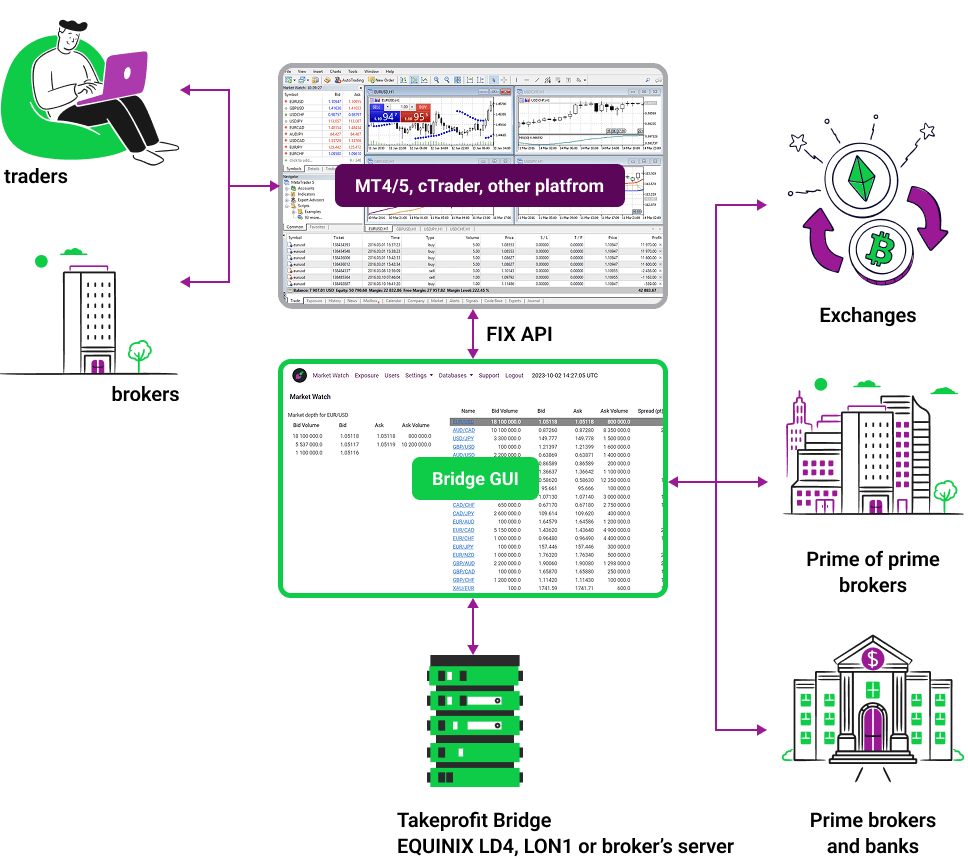
This layer defines how orders move through your broker’s system. A transparent provider shows exactly where each trade is routed, whether to Tier-1 liquidity providers, ECNs, or aggregators. It also discloses whether trades are ever warehoused internally.
Ask your broker these questions:
• Does the firm operate an A-Book or hybrid model?
• Are all orders executed externally?
• Which liquidity providers receive order flow?
A provider unwilling to disclose routing practices is signaling a lack of integrity.
To understand why routing model transparency matters, review the companion article “A-Book vs B-Book: How Broker Models Impact Your Edge.”
2. Pricing Transparency
The second layer concerns how prices are generated and displayed. True transparency means that every quoted price originates from external liquidity, not from synthetic internal feeds.
Professional traders should be able to view aggregated price data, timestamped quote sources, and historical records. These elements allow for real verification of market conditions and prevent manipulation such as spread widening or selective pricing.
In an authentic A-Book environment, spreads fluctuate naturally with market conditions, while synthetic brokers maintain “static” spreads that conceal internal risk management.
3. Reporting Transparency
The final layer involves how results are presented back to clients. A transparent provider supplies comprehensive execution reports detailing fill prices, timestamps, routing paths, and liquidity sources.
For institutional clients, this often comes in the form of Transaction Cost Analysis (TCA) or FIX-based data exports that can be independently audited.
(We explore this process in greater depth in “Transaction Cost Analysis: Best Practices for Pro Traders.”)
How to Identify Real vs. Perceived Transparency
Many brokers claim to be transparent but only surface superficial information—marketing dashboards, generalized summaries, or curated statistics. These are signs of “perceived transparency.” True transparency gives you access to the raw data that underpins those reports.
Ask your provider for:
• Detailed fill logs for every trade.
• Aggregated list of liquidity providers.
• Average slippage statistics (positive and negative).
• Rejection and fill ratio data.
• Time-stamped order routing trails.
A reputable prime-of-prime will provide this data proactively. If a provider refuses, delays, or filters it, you have your answer.
Why Data Consistency Matters
Transparency is only as good as the consistency of the data provided. Brokers can cherry-pick periods of ideal performance to present artificially favorable results. By reviewing multi-period TCA reports, trading groups can ensure accuracy across volatility cycles.
Knight Markets maintains full data continuity, allowing clients to compare live execution against historical metrics at any time. This consistency provides confidence that infrastructure performance is not situational—it is systemic.
The Role of Independent Verification
Third-party analytics and auditing are essential to validating transparency claims. External verification services analyze latency, slippage, and fill rates using anonymized order data. A transparent broker welcomes these audits because the results reinforce trust.
At Knight Markets, we encourage institutional clients to benchmark our execution data using independent validators. Transparency strengthens when numbers are verified externally.
Common Transparency Red Flags
Recognizing the warning signs of opaque operations can prevent costly mistakes. Red flags include:
• A lack of published liquidity provider list.
• Unexplained delays in order confirmation.
• Consistent negative slippage without offsetting positives.
• “Re-quote” behavior in volatile markets.
• Refusal to provide TCA or FIX logs.
• Identical spreads during high and low volatility (indicating synthetic feeds).
Each of these symptoms points to a broker controlling execution internally—often to their advantage.
The Knight Markets Transparency Framework
Knight Markets was founded on a belief that traders deserve institutional-level verification. Our transparency framework includes:
• Full A-Book execution with no internal dealing desk.
• Aggregation across more than sixty Tier-1 liquidity providers.
• Real-time execution reporting.
• Dedicated account-level data analytics and TCA.
• Independent reconciliation of fills and latency metrics.
Transparency isn’t a marketing term—it’s an operational principle. We measure our credibility by the amount of verifiable data we share with clients.
Why Transparency Drives Better Performance
Beyond ethics, transparency delivers measurable financial benefit. When traders understand exactly how orders are executed, they can adjust strategy parameters with confidence. Latency models can be tuned, routing patterns analyzed, and fill assumptions validated.
This feedback loop—data-driven refinement—only works in transparent environments. Hidden routing or opaque reporting destroys this relationship and leaves traders operating blind.
(For further discussion on how low latency and high fill integrity improve profitability, see “Why Execution Quality Matters: Latency, Slippage, and Fill Rates.”)
Transparency and Compliance
For institutional entities, transparency is also a compliance necessity. Regulators increasingly require brokers and trading firms to maintain auditable execution records. A transparent prime-of-prime simplifies compliance reporting by ensuring that all trade data is timestamped, verified, and easily exportable.
By operating within this framework, Knight Markets helps clients meet both operational and regulatory transparency obligations seamlessly.
Building a Culture of Accountability
Transparency is not enforced—it is cultivated. It begins with leadership decisions to prioritize integrity over marketing metrics. Every Knight Markets employee, from technology engineers to relationship managers, is trained to uphold this value. Our systems are designed to make transparency effortless, not exceptional.
When a broker builds its culture around open reporting, traders gain confidence that success is mutual and sustainable.
Why It All Comes Back to Trust
In trading, trust cannot be assumed; it must be earned daily through data, performance, and honesty. Transparency is the mechanism that converts promises into proof. When you can trace every order, audit every fill, and verify every spread, trust becomes more than a word—it becomes quantifiable.
Knight Markets exists to make that trust measurable.
Conclusion
Evaluating execution transparency requires more than marketing research—it requires evidence. Ask hard questions, demand hard data, and never accept vague explanations. The best brokers won’t hesitate to show you everything because integrity thrives in the open.
When transparency, liquidity, and infrastructure converge, institutional trading reaches its highest standard. That is what Knight Markets delivers every day.