Multi-Asset Trading with Institutional Infrastructure: Opportunities and Challenges
The global trading landscape is evolving rapidly. Traders no longer confine themselves to a single asset class—forex, commodities, indices, and digital assets now coexist within unified trading portfolios. Managing this diversity requires more than access; it demands infrastructure engineered for scale, consistency, and precision. Knight Markets was built to support professional groups that operate across multiple asset types, ensuring execution integrity and liquidity depth regardless of the instrument being traded.
Multi-asset trading offers opportunity through diversification, but it also introduces operational complexity. The same systems that deliver speed in one market must ensure stability in another. Understanding how institutional infrastructure supports this balance is essential for modern trading groups.
The Shift Toward Multi-Asset Execution
Institutional traders have traditionally specialized—FX desks handled currencies, futures desks managed commodities, and equities were siloed elsewhere. As technology evolved, data, execution, and liquidity began converging. Today, traders seek to exploit correlations and inefficiencies across markets, blending strategies that span asset classes.
This shift has made the concept of a “multi-asset infrastructure” indispensable. A prime-of-prime provider capable of routing orders seamlessly across forex, metals, indices, and even digital assets gives traders a structural advantage: consistent execution across an entire portfolio rather than fragmented performance.
Knight Markets’ infrastructure is designed to unify access across asset types, enabling professional clients to trade with a single point of control and a common liquidity framework.
Why Infrastructure Matters More Than Access
True multi-asset capability goes beyond simply listing more instruments. It depends on how execution, risk management, and custody interact across those instruments. A broker offering dozens of markets without consolidated infrastructure only multiplies risk exposure.
Institutional infrastructure ensures:
• Standardized order routing regardless of asset type.
• Uniform latency and slippage monitoring across all markets.
• Shared margin and collateral systems for efficiency.
• Consolidated reporting that integrates positions, exposure, and performance.
By maintaining a consistent execution environment, Knight Markets eliminates the operational noise that often arises when traders move between disparate systems.
(For a detailed breakdown of how execution performance affects reliability, see “Why Execution Quality Matters: Latency, Slippage, and Fill Rates.”)
Unified Liquidity Aggregation
Multi-asset trading demands deep liquidity across all products. Each market has unique depth, volatility patterns, and execution behaviors. An institutional provider must aggregate liquidity intelligently to avoid fragmentation and ensure order stability.
Knight Markets connects clients to over sixty Tier-1 liquidity sources for foreign exchange, indices, and commodities, while offering specialized digital-asset connectivity through trusted institutional venues. Aggregation algorithms evaluate pricing depth, quote frequency, and fill ratios in real time to determine optimal routing for every trade.
(For a broader view of liquidity integration, refer to “Deep Liquidity Access: How Tier-1 LPs Change the Game.”)
Managing Margin Across Asset Classes
Trading multiple asset types introduces complex margin interactions. Volatility spikes in one market can influence margin requirements for the entire portfolio. Without a centralized margin framework, traders face inefficiency, overcollateralization, and potential exposure gaps.
Knight Markets manages cross-asset margin through a unified risk engine that dynamically adjusts requirements based on aggregate exposure. This ensures that capital efficiency is maximized without compromising risk protection.
Clients benefit from real-time margin monitoring and automated alerts, reducing the chance of unexpected liquidations.
(For background on risk frameworks, see “Risk Management for Trading Groups Using Prime-of-Prime Infrastructure.”)
Custody and Segregation in Multi-Asset Operations
As the number of traded assets grows, so does the complexity of safeguarding capital. Multi-asset accounts must maintain clear segregation between currencies, collateral, and digital instruments while ensuring all balances remain verifiable and auditable.
Knight Markets enforces custody standards that protect every asset type under one transparent chain-of-custody system. Whether a client is trading major FX pairs, metals, or crypto derivatives, custody integrity remains identical: segregated accounts, independent reconciliation, and bank-level oversight.
For more on this foundational principle, review “Custody, Segregation and Chain of Custody: Protecting Client Capital.”
Cross-Asset Risk and Correlation
Diversification does not always reduce risk. Correlated moves across asset classes can amplify exposure rather than offset it. During macroeconomic shocks, currencies, equities, and commodities may move in lockstep, straining liquidity and margin capacity.
Institutional-grade providers prepare for these scenarios through continuous stress testing and liquidity simulations. Knight Markets monitors correlation matrices and adjusts margin algorithms accordingly, ensuring that capital requirements reflect real-time systemic risk rather than static assumptions.
This proactive approach allows trading groups to sustain performance even during high-correlation events that would destabilize less sophisticated brokers.
Technology as the Bridge
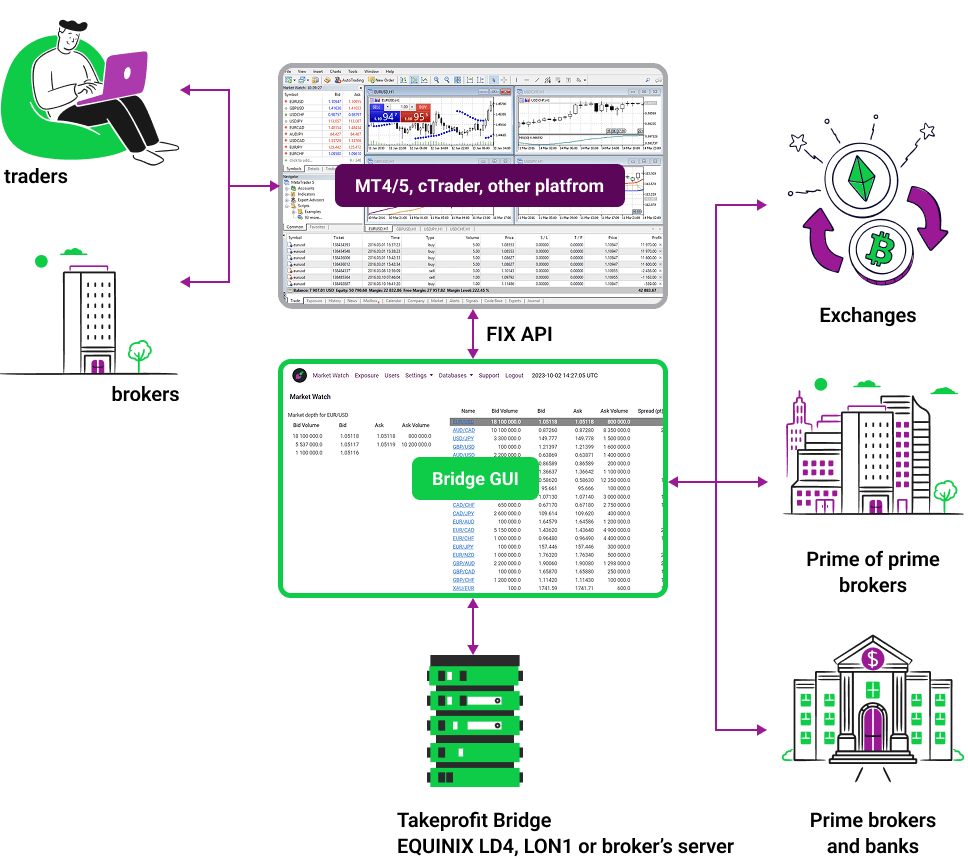
Supporting multi-asset execution requires technology capable of translating complex market data into a unified experience. Knight Markets’ architecture was built around modular APIs and high-speed routing layers that adapt dynamically to asset type and trading volume.
Through FIX connectivity, automated systems can transmit orders across currencies, indices, and commodities without sacrificing latency. The same infrastructure powers both discretionary and algorithmic trading, giving professional clients flexibility without fragmentation.
To learn more about this technological design, see “How Technology Architecture Supports Trading Edge.”
The Challenge of Regulatory Divergence
Different asset classes are often governed by different regulatory bodies and capital requirements. A broker operating across multiple jurisdictions must navigate varying definitions of custody, reporting, and leverage limits.
Knight Markets simplifies this landscape by maintaining compliance across all asset types and clearly communicating jurisdictional restrictions. Our clients trade with full awareness of which instruments are available under each regulatory framework, eliminating uncertainty.
A detailed discussion on this can be found in “Regulatory and Jurisdiction Considerations When Using a Global Prime-of-Prime.”
Institutional Reporting and Data Integration
A key benefit of unified infrastructure is consolidated data. Multi-asset traders need a single source of truth—one that aggregates positions, P&L, and exposure across all instruments. Without this integration, risk management and performance tracking become fragmented.
Knight Markets delivers a comprehensive reporting suite that merges all asset data into one dashboard. Traders can analyze performance by instrument, strategy, or time frame, ensuring that decisions are based on holistic insight rather than isolated metrics.
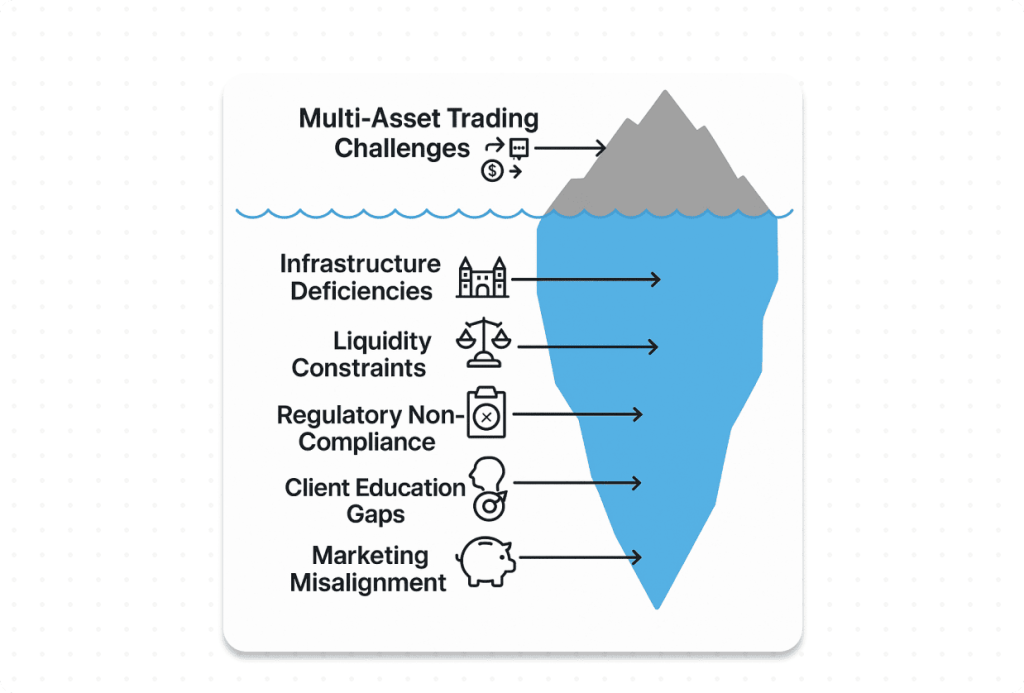
Challenges in Multi-Asset Environments
Despite its advantages, multi-asset trading introduces real challenges. Each asset class has unique liquidity behaviors, volatility dynamics, and operational rules.
Common challenges include:
• Fragmented market data across asset types.
• Differing settlement and clearing cycles.
• Complex cross-margining during volatility spikes.
• Regulatory overlap when trading digital assets.
Institutional traders mitigate these risks through strong infrastructure partnerships. Knight Markets assists clients in designing systems that adapt to each asset’s microstructure while maintaining a unified operational framework.
Future of Multi-Asset Infrastructure
As tokenization and digital-asset adoption accelerate, the definition of “multi-asset” will continue to expand. Professional traders will increasingly demand integrated access to traditional and emerging markets within the same platform.
Knight Markets is actively developing infrastructure to bridge this evolution—combining forex-grade liquidity aggregation with secure digital-asset custody. The result is a future-ready environment where traditional and alternative assets coexist seamlessly.
(For a look ahead, see “Digital Assets and Prime-of-Prime Models: What’s Next for Crypto/FX Hybrids.”)
Conclusion
Multi-asset trading represents both an opportunity and a challenge for institutional traders. Success depends not on the number of markets accessed but on the quality of the infrastructure connecting them.
Knight Markets’ multi-asset framework was engineered to simplify complexity, enhance transparency, and preserve execution quality across all asset classes. By integrating liquidity, risk management, and custody under one system, we empower trading groups to pursue diversification without compromising control.
In a world where markets are converging faster than ever, infrastructure—not leverage—is the new competitive edge.